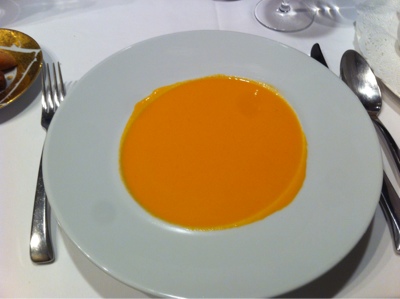
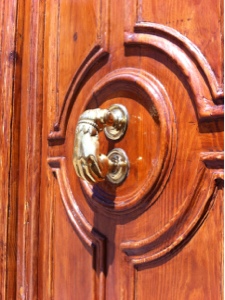
In a move that bodes well for our stomachs if not for our wallets, we went Michelin for our first dinner in Madrid. This was a three-fork restaurant that we first tried at 6:30, but could not figure out how to get past the foreboding and hardly-labeled doors. It turned out to be because the restaurant is open from 9-11.
We went to the Reina Sofia instrad to see Guernica and, while resting at tge bar, Jason made his first Spanish phone call to make a reservation for dinner (an appropriate purpose for his first Spanish phone call, yes?).
We hit the museum during a free time, which was nice since we only had time to see Guernica (sigh!) and a few Dali's before going back to the hotel to change for dinner.
After running into Jason and Senan from PI at the Plaza De Angel, we arrived at the restaurant just after 9. The entrance was through the carriage patio and up a staircase that looked suspiciously like someone's private apartment. We were the only customers in the restaurant for the first twenty minutes of our meal, but we were lead through a series of small dining rooms decorated with grand canvases of modern art. The waiters were attentive and only spoke Spanish, and the food was quite good. I enjoyed watermelon soup (made with cream and olive oil), gazpacho, and some kind of filet with spinach and seared mango. Dessert, pain perdu with honey sorbet, was delicious!
Here are the pictures:
Sunday, July 15, 2012
The Sabatini Gardens
We took a break outside the palace to hydrate and to watch the street performers (giant bubbles!) and the costumed (and drunk) bachelor/bachelorette party.
Palacio Real de Madrid
Photos weren't allowed inside the palace itself, which is a shame since it has one of the most stunning rooms I've ever seen in a royal palace.
Plaza de la Villa
The former town hall was built from 1644-1696 when the capital of Spain moved from Toledo to Madrid.
I like the tiles on the bottom of the balconies:
Mercado de San Miguel
We were super annoyed to stumble onto this while we were stuffed from lunch and churros. Gourmet meats, cheeses, olives, chocolates, and a random booth celebrating Canada? Yes, please! I believe we'll be back for lunch today.
Puerta del Sol y Plaza Mayor
The symbol of Madrid
Kilometer Zero (All roads lead to Sol!)
A building near Sol with paintings of coffee, tea, and cocoa
My favorite trivia for the Plaza Mayor - the paint color was chosen by public vote! The city painted three sample colors on the walls and the citizens selected their favorite.
The lamppost bases depict historic scenes from the Plaza, such as Carnivals.
Lunch at Ginger
Pueblo Ingles - A Summary
I am in a hotel room in Madrid just two blocks away from the Prado (thanks, Mom!) which I am very much looking forward to visiting soon. Jason should be on his way here from the airport, and I enjoyed sleeping in a little this morning before doing a bit more sink laundry (ah, travel! When else do I get to dry a bra using a hairdryer?) and sitting down to blog properly about the past week.
Yesterday was the expected wash of tears and good-byes. I find that a lot of experience at saying good-byes to people I spend a brief, intense amount of time with has rendered me far less emotional and certainly less demonstrative of my emotions than others. There are definitely some people I enjoyed getting to know this past week and others that were a heck of a lot of fun to be around, but we will all move on and go back to reality. At least I will in three weeks. I still, luckily, have a few more adventures left this summer.
While pleasant, this PI was, naturally, different than the one I went to previously. The presence of the Master's students really affected the program. I think this change is actually a good illustration of Spain's economic situation - the business professionals sent by their companies were largely replaced by young adults who can't find a job and so, living at home with parental financial support, are instead working on their fist, second, or third Master's degree.
Of course, the family situations are also cultural - during one group activity Christine asked that anyone who left home at around age 18 raise their hands. Almost all of the Anglos did, including me. The Spaniards reacted with vocal astonishment and disbelief (I wish I could transcribe the "poof" of air from the cheeks and lips with a hand-shake-off gesture that they use for this expression!). Then she asked how many people are still living at home. About a dozen Spaniards raised their hands, this time to the surprise of the Anglos. The closeness, literally, of families in Spain was a much-discussed topic this week. The Spaniards I talked with in one-to-ones couldn't understand my mobile life anymore than I can imagine living in the same neighborhood as not only my parents and siblings, but also my aunts, uncles, cousins, grandparents, etc. The Spaniards all acknowledged that it was an issue, that the unwillingness to leave their hometowns for employment elsewhere was a big part of the economic disaster, but few of them seemed open to the idea of being the first to leave.
In addition to the illustrative change in attendees, the overall youth of the group also changed the social dynamics. The eight Master's students knew each other very, very well, which set up an imbalance from the start. Where before everyone was on equal social footing as strangers, now we were divided between those who were friends already and, well, the rest of us.
A bit to my surprise, I found my high school insecurities flaring up at the presence of a group of young adults who were not only clique-ish, but also good-looking, dressed to the nines, and European. I was apprehensive about doing one-to-ones with them, worried about what we could possibly find to talk about for an hour, worried that they wouldn't want to talk to me.
Which was, of course, ridiculous. Gema, a mid-twenties woman with short skirts, high heels, big earrings, and all of the traits of the girls who wouldn't give me the time of day in high school spent the hour talking about our shared passion for art history and her conflict between doing what she loves and doing "real work" as her parents called it. Carlos, a mid-twenties man in pink shorts, a shirt unbuttoned halfway down down his chest, designer sunglasses, spiked hair, who sat at an angle so he could stretch out his legs and sling one arm over the back of the chair oh so casually; Carlos was fascinated by my observations of body language in the group and we argued over whether handwriting analysis has any scientific merit. Even Juan, the most popular, outgoing, clownish young man with a perpetual beer bottle in hand, spent the hour entertaining me with tales of his sexual exploits in previous Pueblo Ingles programs (the Master's students complete four within 10 months as a part of the degree. This was their last one).
I wouldn't say I am friends with any of them now, but they stopped being an unapproachable group and became individuals I knew and who, to some degree, knew me. Which made me wonder if this could happen in high school. If every student spent an hour speaking face to face with another student - not working on an assignment, but actually talking about themselves or their families or politics or tv shows or whatever; if you had an hour to spend talking with a kid who was completely outside your circle of friends, would the social categorizations and divisions change? Would it be easier to change who you sit with in the cafeteria and harder to make fun of someone you actually know?
I don't know. The rigid divides of high school might not be completely surmounted by a simple conversation, nor do I know how such a thing would be organized. But, as Nadia pointed out at our "graduation ceremony," the relationships and camaraderie of this week happened because it was a week about communication. 45 adults dedicating a week of their lives to becoming better at communicating is unusual, especially between so many different countries and cultures, but it's why doing Pueblo Ingles is so satisfying and so worthwhile.
(It's Sunday now, by the way. Jason actually arrived before I finished that entry, and I wrapped it up instead over breakfast at the restaurant in our hotel. Next up, the tale of our Saturday!)
Yesterday was the expected wash of tears and good-byes. I find that a lot of experience at saying good-byes to people I spend a brief, intense amount of time with has rendered me far less emotional and certainly less demonstrative of my emotions than others. There are definitely some people I enjoyed getting to know this past week and others that were a heck of a lot of fun to be around, but we will all move on and go back to reality. At least I will in three weeks. I still, luckily, have a few more adventures left this summer.
While pleasant, this PI was, naturally, different than the one I went to previously. The presence of the Master's students really affected the program. I think this change is actually a good illustration of Spain's economic situation - the business professionals sent by their companies were largely replaced by young adults who can't find a job and so, living at home with parental financial support, are instead working on their fist, second, or third Master's degree.
Of course, the family situations are also cultural - during one group activity Christine asked that anyone who left home at around age 18 raise their hands. Almost all of the Anglos did, including me. The Spaniards reacted with vocal astonishment and disbelief (I wish I could transcribe the "poof" of air from the cheeks and lips with a hand-shake-off gesture that they use for this expression!). Then she asked how many people are still living at home. About a dozen Spaniards raised their hands, this time to the surprise of the Anglos. The closeness, literally, of families in Spain was a much-discussed topic this week. The Spaniards I talked with in one-to-ones couldn't understand my mobile life anymore than I can imagine living in the same neighborhood as not only my parents and siblings, but also my aunts, uncles, cousins, grandparents, etc. The Spaniards all acknowledged that it was an issue, that the unwillingness to leave their hometowns for employment elsewhere was a big part of the economic disaster, but few of them seemed open to the idea of being the first to leave.
In addition to the illustrative change in attendees, the overall youth of the group also changed the social dynamics. The eight Master's students knew each other very, very well, which set up an imbalance from the start. Where before everyone was on equal social footing as strangers, now we were divided between those who were friends already and, well, the rest of us.
A bit to my surprise, I found my high school insecurities flaring up at the presence of a group of young adults who were not only clique-ish, but also good-looking, dressed to the nines, and European. I was apprehensive about doing one-to-ones with them, worried about what we could possibly find to talk about for an hour, worried that they wouldn't want to talk to me.
Which was, of course, ridiculous. Gema, a mid-twenties woman with short skirts, high heels, big earrings, and all of the traits of the girls who wouldn't give me the time of day in high school spent the hour talking about our shared passion for art history and her conflict between doing what she loves and doing "real work" as her parents called it. Carlos, a mid-twenties man in pink shorts, a shirt unbuttoned halfway down down his chest, designer sunglasses, spiked hair, who sat at an angle so he could stretch out his legs and sling one arm over the back of the chair oh so casually; Carlos was fascinated by my observations of body language in the group and we argued over whether handwriting analysis has any scientific merit. Even Juan, the most popular, outgoing, clownish young man with a perpetual beer bottle in hand, spent the hour entertaining me with tales of his sexual exploits in previous Pueblo Ingles programs (the Master's students complete four within 10 months as a part of the degree. This was their last one).
I wouldn't say I am friends with any of them now, but they stopped being an unapproachable group and became individuals I knew and who, to some degree, knew me. Which made me wonder if this could happen in high school. If every student spent an hour speaking face to face with another student - not working on an assignment, but actually talking about themselves or their families or politics or tv shows or whatever; if you had an hour to spend talking with a kid who was completely outside your circle of friends, would the social categorizations and divisions change? Would it be easier to change who you sit with in the cafeteria and harder to make fun of someone you actually know?
I don't know. The rigid divides of high school might not be completely surmounted by a simple conversation, nor do I know how such a thing would be organized. But, as Nadia pointed out at our "graduation ceremony," the relationships and camaraderie of this week happened because it was a week about communication. 45 adults dedicating a week of their lives to becoming better at communicating is unusual, especially between so many different countries and cultures, but it's why doing Pueblo Ingles is so satisfying and so worthwhile.
(It's Sunday now, by the way. Jason actually arrived before I finished that entry, and I wrapped it up instead over breakfast at the restaurant in our hotel. Next up, the tale of our Saturday!)
Saturday, July 14, 2012
Friday, July 13, 2012
Grandma Cook Would Approve
Don't hotels realize why one books a room with two twin beds in the first place? :)
I have some furniture rearranging to do.
Food at PI
Per tradition, and much to the curiosity of my dinner companions, I took photos of all of our meals at PI. I've uploaded them to my Flicker account (link in the sidebar) if you're interested.
Below are a few extra pictures: Christine and our wait staff; Allison, Rosemarie, and I just before dinner the last night; a sample day's menu (we choose our first and second choices from a short list the day before and write them on a board); and the judgmental deer than looked disapprovingly down on any meal choice you made, even if it was vegetarian.
It was delicious and far too heavy for daily fare. I miss the incredibly simple meals Jason and I favored prior to this trip, and I wonder if it'll be possible to go vegetarian for a while here....
Below are a few extra pictures: Christine and our wait staff; Allison, Rosemarie, and I just before dinner the last night; a sample day's menu (we choose our first and second choices from a short list the day before and write them on a board); and the judgmental deer than looked disapprovingly down on any meal choice you made, even if it was vegetarian.
It was delicious and far too heavy for daily fare. I miss the incredibly simple meals Jason and I favored prior to this trip, and I wonder if it'll be possible to go vegetarian for a while here....
Thursday, July 12, 2012
What I Got
I received this postcard at dinner, presented by "Andrea," the drag personna Ander developed while doing a scene earlier in the week. The presentation included a very curly wig and a bit of naughty talk.
My Invisible Friend Present
I never turn down the chance to be crafty! The hotel gave me a napkin and I have my travel embroidery kit with me.
Subscribe to:
Posts (Atom)